
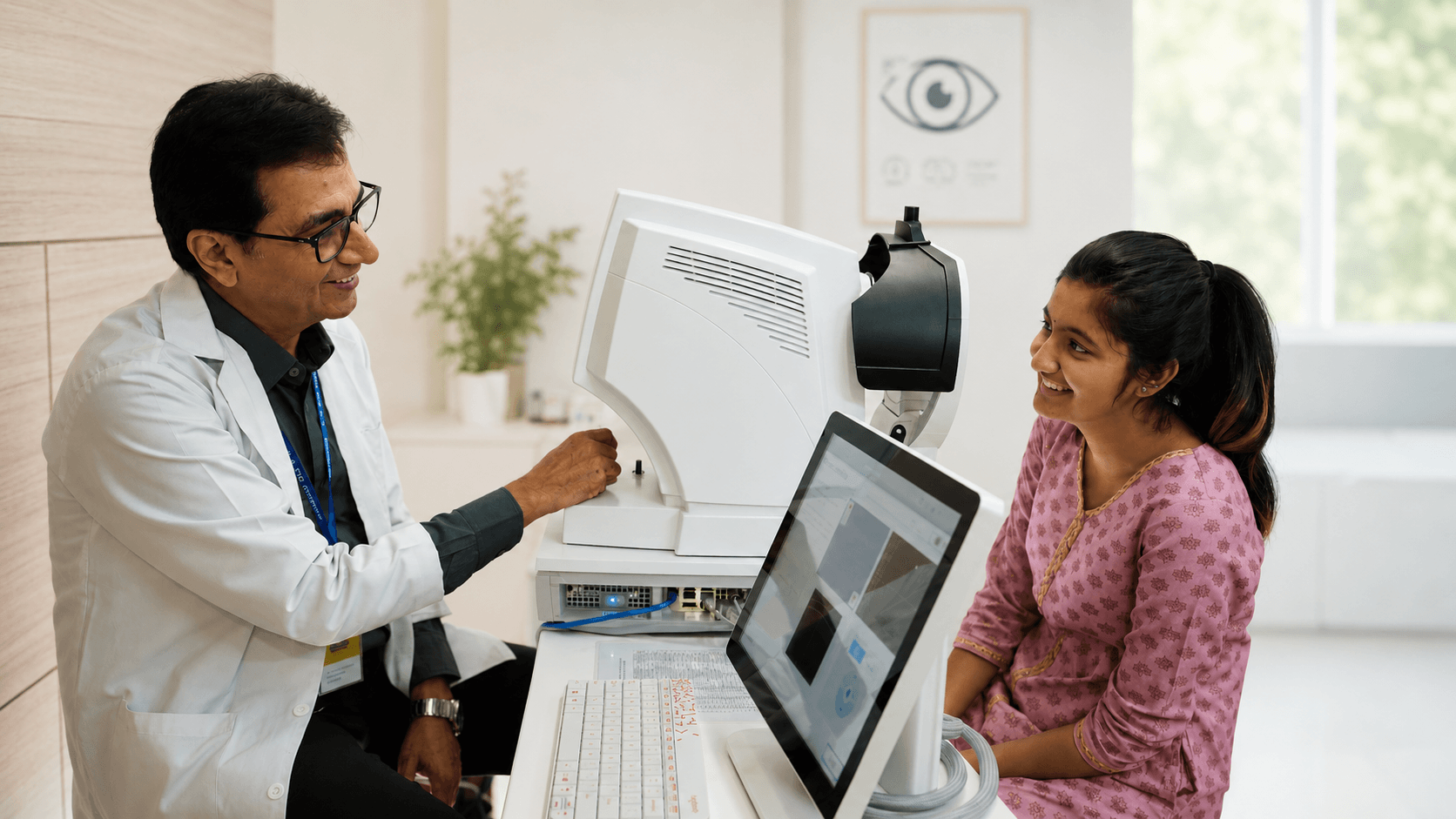
A closer look at what is involved in preparing for a smooth run pre and post op, what you can realistically expect and how to get through it with a smile.

Mr. Oculus says:
As explained before, LASIK is short for Laser Assisted in-situ Keratomileusis, introduced as second generation Refractive Surgery. To state a simple fact: understanding what exactly the surgery entails, including its potential side-effects or risks and benefits is the first step. Here’s all you need to know about how to gear up with information, planning and pre and post-operative measures.
What to expect before the procedure?
Pre-op evaluation: In a detailed evaluation, your eye doctor will ask about your medical and surgical history and carry out a thorough check up to assess whether this procedure is for you. They will evaluate your eye in detail: inflammation or infection in the eye/dry eyes/large pupils/high eye pressure etc. Wavefront-guided technology will help to measure the cornea, its shape, thickness, contours and irregularities. Your eye doctor will now evaluate which areas of your cornea need reshaping and just how much tissue needs to be removed
Chat with your doctor: As your doctor takes you through the pros and cons of the procedure, feel free to ask him/her any questions you might have. Do not leave out the minutest detail including arrangements of patient care after surgery.
Before surgery, your doctor will discuss the risks and benefits of LASIK surgery, what to expect before and after surgery, and any questions you may have.
Breaking contact with contacts: This may be an inconvenience, but it’s absolutely necessary to discontinue the contact lenses before surgery. Typically, it would be one or two weeks depending on the type of your lenses.
Let someone else be in the driver’s seat: A driver must accompany you, at the very least to drive you back home. Family, friends, or a professional-anyone will do, provided they are safe and trustworthy.
• Ditch the make-up and perfume. This includes your favourite kohl pencil. This is absolutely necessary for healing and hygiene’s sake.
• Eat well before the process.
• Wear loose comfortable clothing preferably natural fabrics like cotton and linen.
• You need a responsible adult attendant on the day of the surgery.
• Arrive on time on the day of the surgery.
• You will be required to sign the consent form after which you will be escorted to the laser room. Feel free to ask as many questions as you want-if you haven’t done so already.
What to expect during the procedure?
LASIK surgery is usually completed in 30 minutes or less. After numbing drops are placed in your eye, your doctor uses an instrument to hold your eyelids open. A suction ring placed on your eye just before preparing the corneal flap may cause a sense of pressure. Your eye surgeon uses a small instrument or laser to raise a small, hinged flap away from the front of your eye. Folding back the flap allows your doctor to access the part of your cornea to be reshaped.
Using a programmed laser, your eye surgeon reshapes parts of your cornea. After reshaping the cornea, the surgeon puts the flap back into place. This is usually done sans stitches. For those who need LASIK surgery in both eyes, doctors will generally conduct the procedure on the same day.
Temporary side-effects of surgery
- Dry eyes: LASIK could cause a temporary decrease in tear production foras many as 6 months post-op. You may be given some eye drops to ease the experience. In extreme cases, you would be helped by another procedure to get special plugs put in your tear ducts to prevent your tears from draining away from the surface of the eye.
- Glare, halos and double vision: Difficulty seeing at night, glares and halos around bright lights plus double vision are a temporary side-effect.
- Astigmatism: This could be due to uneven tissue removal. You might need an extra surgery, glasses or contacts to ease this up.
- Corneal ectasia: This is a serious complication and is the result of progressive myopia due to steepening of curvature of the cornea.
- Under and overcorrections: As the names suggest, removing too little or too much tissue from the eye are a problem either way. Under corrections are common in cases of nearsightedness. You could require another surgery within a year to remove more tissue. However, overcorrections are more difficult to fix than under corrections.
- Flap problems: Folding back or removing the flap from the front of your eye during surgery can cause complications such as excess tears and infection. Also, the outermost corneal tissue layer (epithelium) may grow abnormally underneath the flap as the eyes heal.
- Vision loss or changes: Very rarely, there could be loss of vision due to unexpected issues. Some may not see as sharply or clearly as before.
- Red spots of blood on the white part of the eyes.
- Foreign body, itchy scratchy sensation.
Post-surgery precautions and care
- Do not rub or squeeze your eyes for at least 7 days
- Be mindful of using eye drops as told by your doctor. Either have someone responsible do it for you or consider setting a reminder on your phone-whatever works best!
- Wear sunglasses
- No make up for eye or face for a week
- Avoid pools, contaminated water and hot tubs for a week
- No sports for a week, or longer, if your doctor advises.
- Eye shield for the duration indicated by the doctor-usually the first three nights after the surgery.
- Call your clinic or hospital in case of severe pain that can’t be relieved by the prescribed pain medications.
- Do not miss any of your post-operative appointments
- Any travel must be with the sanction of your doctor.
- How long you must wait to drive depends on case to case. However, most people are given permission within 1-3 days.
Please note that full recovery including stabilised vision will take 3 to 6 months. Your doctor will regularly check on your progress. Most patients will have good to perfect vision for many years or decades. Your lifestyle will be active and unrestrained from sports to travel and trekking, without needing glasses or contacts. But no one’s immune to the advances of age-not even LASIK surgery. As you get older or are in low-light conditions, the glasses would help. However, most people are very happy with the outcome.
Please do note though that even when doing post-op follow ups, vision is tested under optimal conditions. Vision in dim light (fog/stormy conditions/dusk) may not be as great. In short, expectations need to be realistic and practical!