
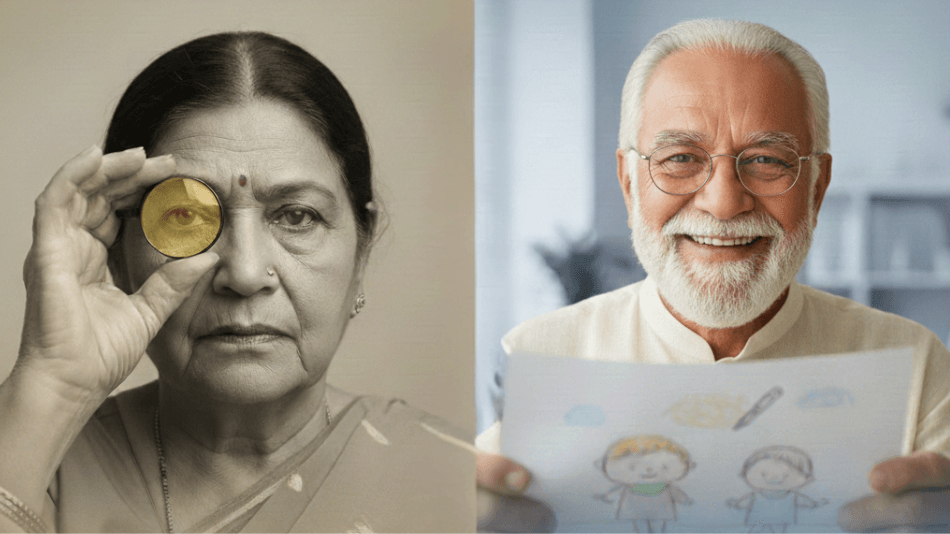
Given that cataract is the leading cause of blindness in India, ignorance is most certainly not bliss, cautions a stern Mr. Oculus. Here is a separation of fact from fiction regarding cataracts

A philosopher once said:
“No matter how well your eyes adjust to the darkness, you will never mistake it for light.”
A profound sentence that sums up a profound life truth: human senses are able to discern a fundamental truth for themselves, sans error, no matter how much time has elapsed.
If only this were true when it came to dealing with the most widely spread eye disorder, cataract. Myths abound when it comes to dealing with this condition-tall tales that unnerve the patient and consequently delay or derail the medical treatment. Sometimes with tragic consequences.
And that’s why Mr. Oculus is here to walk you through the most common cataract myths vs facts.
Myth No. 1: I can delay/dissolve the cataract through a healthy diet combined with a clean lifestyle. I do 50 Surya namaskars a day!
Fact: Cataracts are not a disease. They are a natural outcome of the ageing process. At some point, all of us will develop cataracts in our eyes, sooner or later.
So, there’s pretty much no eye drop on any chemist’s shelf or lifestyle change that can be a deterrent. And while yoga or any other form of moderate exercise done consistently will keep you in ship-shape, the same doesn’t hold true for your peepers!
Cataracts are 100% curable but the only way is through cataract surgery.
That said, living as we do in a hot country like India, sunglasses and a healthy diet with Vitamin C are always a good idea, for they may slow down the progress of the cataracts.
Myth No 2: Cataract can come back.
Fact: Dear reader, let me assure you that this is technically not possible. Let’s quickly look at the definition of cataract again: Cataract is clouding of the clear, natural lens of the eye. Thus, in the course of cataract surgery, your surgeon will essentially replace the cloudy lens of your eye with a new artificial lens. So how can it grow back?
What can happen by way of post-operative complication, though, is a secondary cataract, also called posterior capsule opacification. This is the result of protein accumulation on the posterior lens capsule of the eye-which contains the IOL implanted during the operation. However, there is a treatment for it called capsulotomy. The ophthalmologist will decide whether or not to perform this intervention depending on the visual condition and medical history of each patient.
PS: Be sure to check out my blog on intraocular (IOL) lenses used in cataract surgery.
Myth No. 3: Only the old are affected by it.
Fact: Unfortunately, it’s not that simple. Sure, cataracts are more common in old age but they could also be congenital, hereditary or the result of an injury to the eye. They can even be the result of medical conditions such as hypertension, diabetes, stress or nutritional deficiencies and poor lifestyle choices such as smoking.
Myth No. 4: Cataract Surgery should be performed in later stages.
Fact: With advances in technology, cataract surgery today can be performed in the initial stages. In fact, we recommend surgery before the condition worsens.
The concept of “Has the cataract ripened?” is very old and obsolete and not applicable today when surgeries are done with machines under microscopes.
Myth No. 5: Cataract Surgery is risky and takes time to heal.
Fact: Nothing could be further from the truth. As the mascot for healthy and clear eyes, I am happy to tell you that it is one of the safest medical procedures and a fairly painless one at that-the numbing eye drops administered during the process make sure of that. Agreed, your eyes could feel achy for a few days afterwards, but nothing that a few painkillers can’t take care of! While the healing time differs from person to person, you can resume day-to-day activities once the eye patch is removed, in as little as a day or two.
Myth No 6: Umar ho gayi hai-toh operation karke kya fayda?
(I am ageing, so what’s the point of surgery?)
Fact: Just because you are old doesn’t mean you don’t deserve or need good medical attention. It’s imperative that we treat cataracts on time because they become progressively worse and can impact your vision. Performing simple day to day tasks such as reading, walking or driving will get tougher by the day. In the worst-case scenario, you could go completely blind. Why let that happen to you? This is one of the most common cataract surgery myths.
Myth No 7: Cataracts are growths.
Fact: A cataract is a clouding of the eye lens, not a growth on the eyeball. The reason for its occurrence is that the transparent proteins in the lens have lost their elasticity and tend to clump together. As the days go by, the clump builds up, thereby fogging your eyes. This misunderstanding is a frequent cataract misconception.
Myth No. 8: They spread from one eye to the other.
Fact: Again, this is technically not possible for the simple reason that there is no mechanism to facilitate such a spread! Yes, due to age/injury/genetics, they may develop in both eyes at approximately the same time, or in one eye only. But the development is independent of each other. Cataracts do not spread between eyes.
Myth No. 9: They simply make your vision hazy.
Fact: Sorry, this just isn’t the case. Hazy vision is just a possible symptom of the cataracts. You see, the very nature of cataracts is such that they interfere with the way light refracts through the lens. So, colour changes/fade-outs, double vision, halos and increased sensitivity to glare in the dark are the other outcomes. These are recognised cataract symptoms.
Myth No. 10: I will continue to be short-sighted afterwards
Fact: Who told you such a whopper?! One of the greatest benefits of cataract surgery is that be it long-sightedness or short-sightedness or astigmatism, we can correct them all through the tiny intraocular lens (IOL) implanted in the eye.
Advanced design of artificial IOL (intraocular lenses) offers clear, enhanced vision. Let’s see Cataracts as an opportunity to get a ‘second sight’, a second chance to see clearly again in old age. Another common cataract surgery misconception.
So, there you have it a nutshell, dear reader. I have hopefully busted the myths and spread the light- the very same light for which darkness can never be a substitute !!
Reference: (Assorted research papers, medical sites and news reports.)