
Intraocular lenses are implanted in the eye as part of a treatment for cataracts. Mr. Oculus walks you through the basics.
The old and the wise say that big is not necessarily better, sometimes that which looks small and unassuming can make all the difference between night and day, hope and despair!
They could well be talking of the tiny, artificial lens called the intraocular lens which replaces the eye’s natural lens that is removed during cataract surgery.
Just imagine: your cataracts are preventing you from seeing properly, day to day tasks are a pain, and you find your movements getting increasingly restricted.
Enter the IOL and the picture clears completely! Just like magic except that it isn’t-it’s modern-day medical technology to the rescue!
Shape matters!
Lenses come in different focusing powers just like prescription glasses or contact lenses. To customize them to your specifications, your ophthalmologist will measure the length of your eye and the curve of your cornea. (yes, they differ from person to person!) This will help decide the power of your IOL.
In case you are wondering whether it’s safe to insert a foreign body in your eye permanently, don’t worry. They are made of biocompatible, medical-grade materials like acrylic, plastic blends or silicone that will function safely, throughout your life. In fact, IOLs have a special coating that will protect your eyes from UV rays of the sun, acting like built-in sunglasses for your eyes.
A feature common to all advanced IOL’s (foldable and non-foldable) is edge correction. What this means is that chances of PCO or Posterior Capsular Opacification (diminished transparency) of the surface/capsule on which the IOL is implanted are reduced.
Spherical vs. aspherical IOL
IOLs are either spherical or aspherical in shape.
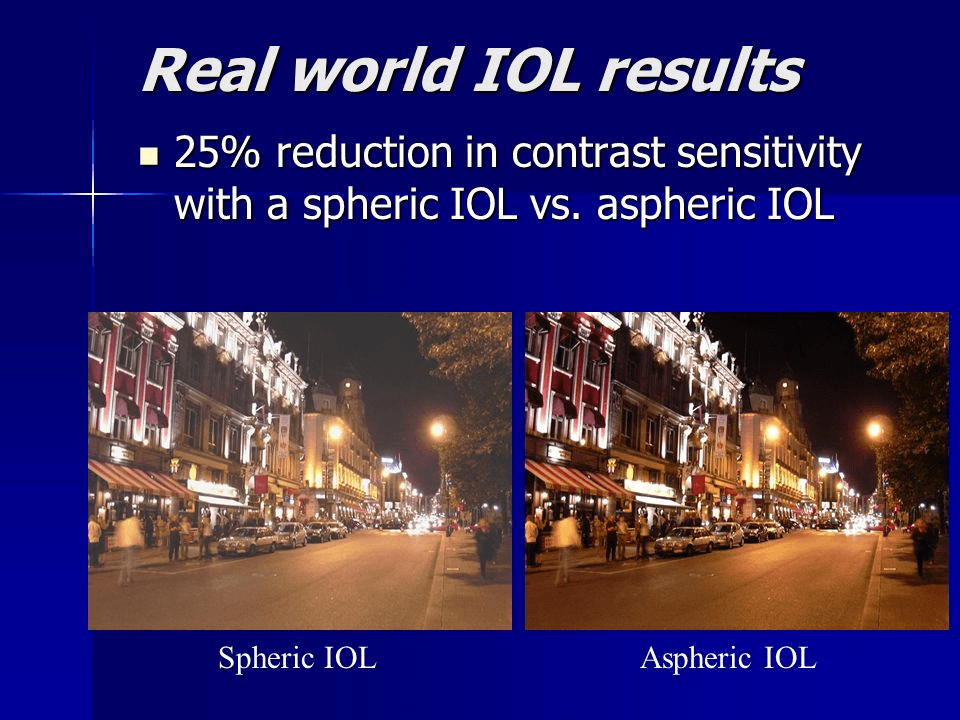
The former are the traditional lenses with a spherical optical design, meaning the front surface is uniformly curved from the centre of the lens to the periphery. This design, however, does not mimic the natural lens inside the eye which is aspheric or not spherical. This means a spherical lens could induce minor imperfections which can affect vision particularly in an environment of low-light such as walking or driving at night.
And that’s why, dear readers, premium aspherical lenses are so important. These closely match the shape and optical quality of the eye’s natural lens and thereby provide sharper vision irrespective of the light.
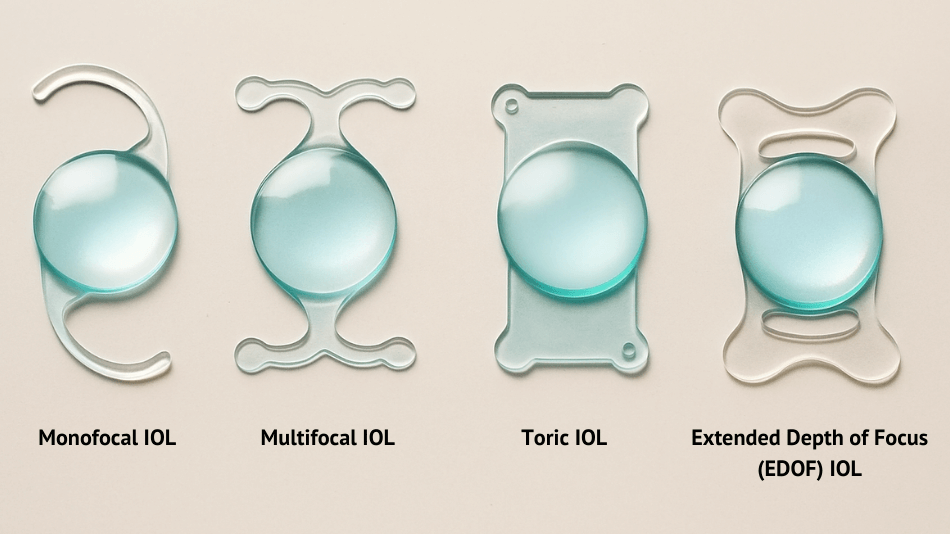
Monofocal IOL
The most widely used lens for cataract surgery is the monofocal IOL. As the name suggests, it is set to focus for one focusing distance-close, medium range or distance vision. For instance, you could have them set for clear long-range vision. For reading, knitting, sewing, cooking and other close work, one could use glasses.
Multifocal IOL
These nifty and hi-tech IOLs provide both distance and near focus at the same time. The lens has different zones set at different powers-all the better to expand your range of vision to see objects at varying distances sans glasses or contact lenses. Phacoemulsification surgery is the usual option for those who choose multifocals, because nothing less than perfect alignment will do for fabulous vision at all distances!
EDOF IOL
EDOF lenses are designed to give you clear vision across a wide range of distances. This means you can see well for activities like driving or watching TV, while also having good vision for tasks at arm’s length, such as using a phone or working on a computer. They provide smoother transitions between distances and often give better contrast, making vision feel more natural and comfortable.
Toric IOL
This IOL is especially meant for astigmatism, a refractive error that is due to an uneven curve in your cornea/lens. These clever little IOLs can work wonders for astigmatism as they possess varying power in different meridians of the lens. The alignment markings on the periphery of the lens make it easy for the surgeon to adjust the IOL in such a way that it can correct astigmatism to the maximum.
Different strokes for different folks, err, eyes
The same person may have two different issues in both eyes. Say you have cataracts in both eyes, but one is more astigmatic than the other. In such cases it makes sense for the doctor to use a different type of IOL for each eye: a toric IOL in the astigmatic eye and an accommodating lens in the other!
A wee bit of risk and tons of rewards
Like all surgeries, IOL replacement comes with its share of risks. One has to watch out for inflammation or infection, a possible rotation of the lens or nighttime halos.
But a good hospital and eye surgeon will take care of these. Best of all, the cataract is gone forever, as the lens has been removed. One con, however, is that the eye’s ability to accommodate different areas of focus is reduced and is limited to the kind of lens implanted.
The surgery and thereafter
Before the entry of IOLs in the eighties, post-cataract, patients had no choice other than to wear very thick eyeglasses or special contact lenses in the absence of a device to substitute for the natural focusing power of the natural lens.
Today, though, the procedure is carried out under local anaesthesia and the patient is conscious during the surgery. A flexible IOL facilitates the lens to be inserted into the capsule through a very small incision, avoiding the need for stitches. Time taken is about 30 minutes with a recovery period ranging from 2 to 3 weeks. Post-surgery, you need to take it easy for a good 6 to 8 weeks. This means no heavy exercise or stress inducing activity that can push up the blood pressure a few notches!
Periodic and scheduled follow ups with your ophthalmologist are a must.