
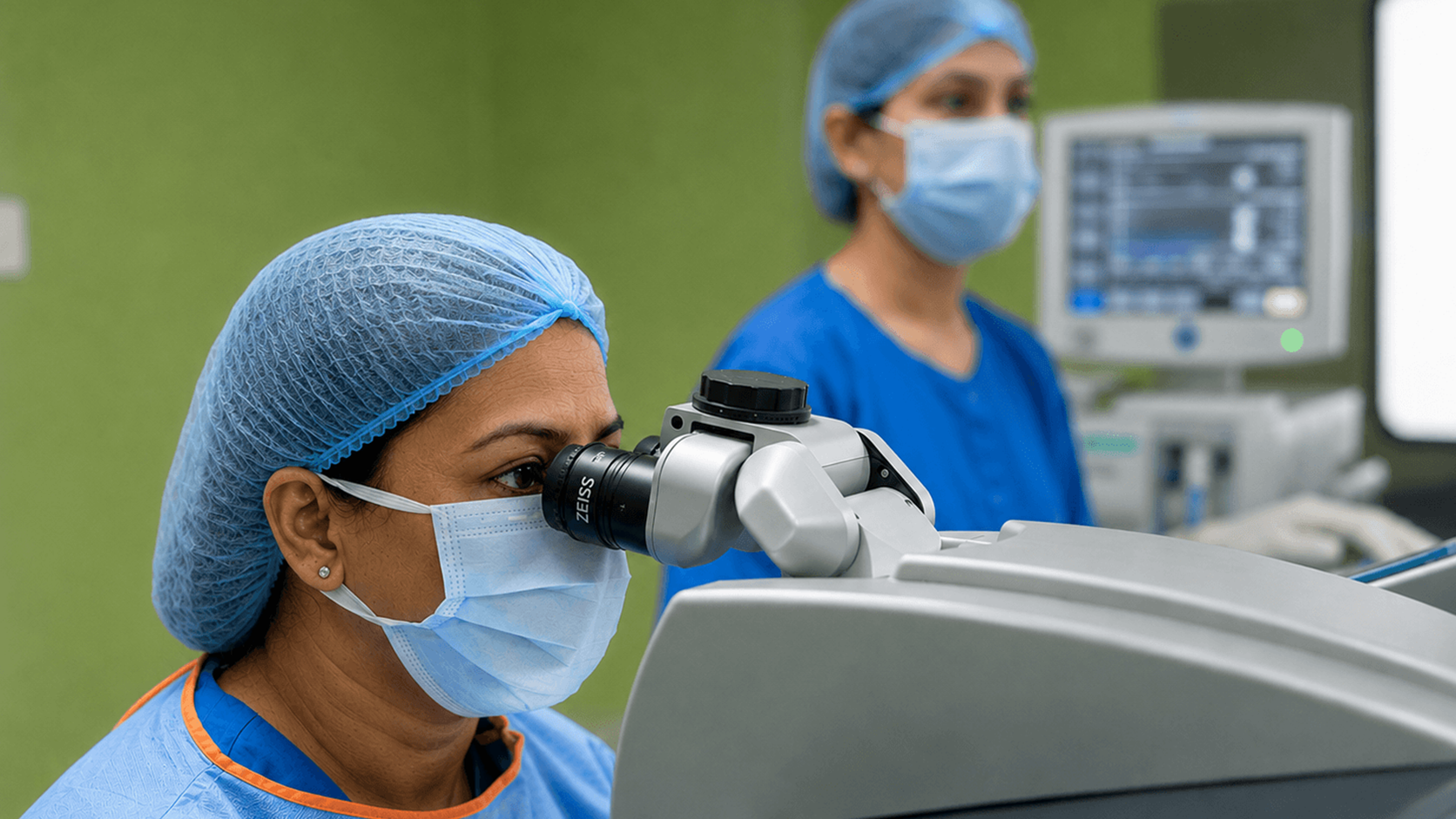
LASIK is a painless laser procedure for the eye that helps people see clearly without needing glasses or contact lenses. While the technology is advanced, choosing the right surgeon plays the most important role in ensuring safe, precise, and longlasting results.
Let’s understand what to look for in a LASIK surgeon and why your choice matters more than you think.
Why Does the Surgeon Matter More Than the Laser?
During a LASIK procedure, a laser is used to reshape the cornea (the front clear part of the eye). This precision treatment requires precise corneal assessment, accurate flap creation, customised laser planning and expert handling of complications– all of which come with choosing a qualified and experienced eye surgeon with a strong clinical judgement.
Even with the best technology, the outcomes of LASIK depend on the surgeon’s experience, skill, and decisionmaking
What are Some Key Qualities to Look for in a LASIK Surgeon?
Before you opt to undergo LASIK, here are some qualities to evaluate in a surgeon:
⦁ Experience and surgical volume
Choose a surgeon who has over 15+ years of experience performing LASIK procedures. High surgical volume correlates with:
⦁ Better accuracy
⦁ Lower complication rates
⦁ Greater confidence in handling variations
Ask your eye surgeon about their experience openly.
Specialisation in cornea & refractive surgery
LASIK is a corneal procedure. So, a surgeon who is trained specifically in cornea and refractive surgery is better equipped to:
⦁ Evaluate corneal thickness
⦁ Identify risk factors
⦁ Personalise treatment
⦁ Manage rare complications
Access to advanced LASIK Technology
LASIK technology is constantly evolving, and modern LASIK devices use advanced technology, such as
⦁ Contoura Vision
⦁ Wavefrontguided or topographyguided treatments
⦁ Highprecision excimer lasers
⦁ Corneal mapping and tomography
Pick a surgeon who uses the latest LASIK device, as the advanced lasers ensure safer, more predictable outcomes.
Transparent presurgery evaluation
A good surgeon will conduct a detailed assessment, which typically includes:
⦁ Corneal thickness
⦁ Corneal shape and stability
⦁ Tear film quality
⦁ Pupil size
⦁ Refractive error stability
⦁ Screening for dry eye or keratoconus
It’s okay if it takes a little longer, as it gives the surgeon adequate time to understand your concern and create a suitable treatment plan. If a surgeon rushes the evaluation, consider it a red flag.
Honest communication about eligibility
Not everyone is a candidate for LASIK. A trustworthy and genuine eye surgeon will tell you when LASIK is not advisable and may suggest alternatives like:
⦁ Photorefractive Keratectomy (PRK): It is similar to LASIK but does not require the flap to be raised. It is best for thin corneas, active individuals, and mild irregularities.
⦁ Small Incision Lenticule Extraction (SMILE): This is also a flapless, minimally invasive laser procedure that is best suited for dry eyes, an active lifestyle, and moderate cases of myopia.
⦁ Implantable Collamer Lens (ICL): This involves placing a permanent contact lens inside the eye without requiring corneal reshaping. Best suited for people with high power, thin corneas, and dry eyes when laser is not an option.
Clear explanation of risks and expectations
LASIK is safe, but like any procedure, it has risks. If your surgeon explains the potential risks of the procedure and what to expect, consider it a green flag. Your surgeon should explain:
⦁ Dryness
⦁ Glare or halos
⦁ Temporary fluctuations
⦁ Rare complications
Clear communication builds trust and confidence.
Strong postOperative care
Postoperative care is essential for optimal results, and good surgeons don’t disappear after the procedure. They ensure regular follow-ups, monitor healing, address dryness (if any), and maintain long-term vision stability
Questions You Should Ask Your LASIK Surgeon
Before undergoing any procedure, it is common to have several questions or concerns. Here are some questions you should ask your LASIK surgeon:
⦁ How many years of experience do you have in performing LASIK surgeries?
⦁ What technology do you use?
⦁ Am I a good candidate for LASIK?
⦁ What results can I realistically expect?
⦁ What are the risks in my specific case?
⦁ What is your enhancement (touchup) policy?
These questions can help you make an informed decision
Key Takeaway
LASIK is a lifechanging procedure, and choosing the right surgeon is the most important step in your journey to clearer vision. When choosing a surgeon for LASIK, look for expertise, transparency, advanced technology, and a patientfirst approach.
Ready to leave your glasses behind? Book your LASIK consultation at K K Eye Institute today!