

Contoura Vision Surgery, also known as topography-guided LASIK is a more sophisticated version of LASIK with great benefits on offer-especially for those who will have limited outcome with Conventional LASIK.
Nothing in life is perfect. But there are a few surgeries that do come pretty close. Personalised, precise, cutting-edge and customized, Contoura vision surgery is LASIK with a next level upgrade – safer, more precise and with better results.
In a nutshell; Contoura-Vision is LASIK aided by advanced imaging technology and AI that is pretty much the most advanced surgery to remove one’s specs with far sharper vision outcomes that LASIK and SMILE can’t bring about.
How is Contoura different from Conventional LASIK?
To begin with, Contoura has a far wider scope than LASIK as it goes beyond vision correction to treat any abnormality in the curvature of the Cornea. What’s more, the outcome of Contoura is superior in terms of visual clarity and reduction in refractive error. While LASIK surgery can map about 200 points on the cornea, the Contoura vision surgery maps a whopping 22,000 points on the cornea.
With high safety standards, it has fewer complications, damage to the tissue is minimal and so is the healing time. Top of the charts is the patient’s comfort and convenience, as Contoura surgery entails no injections, stitches or bandages, and the patient may go home the very same day as the surgery.
How it all began – rewind to the past
Human-kind has been known to strive for clear, crisp vision and greater clarity of eyesight from the very beginning of civilisation.
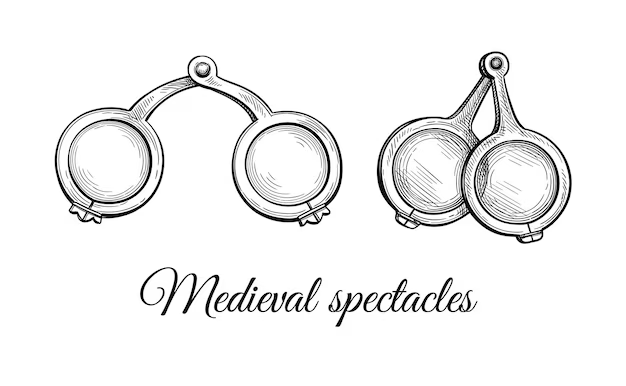
However, spectacles as a means to correct vision came in as late as the 13th century in Italy. But they were pretty different to what we are used to today: primitive glass-blown lenses were set into frames of leather/wood or animal horn and either held before the face or perched on the nose-as shown by Renaissance paintings in Europe.
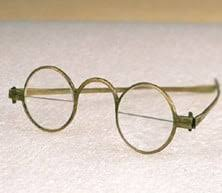
By the 1700s, glasses were “hands-free” and “over the ear”. Benjamin Franklin invented the bifocal lens which allowed a person with both near and far-sighted vision to use a single pair of glasses instead of two.
By the 1800s, contact lenses were available, manufactured from hand-blown glass. Thus, through the ages, there have been many non-invasive methods of correcting vision. But these devices were uncomfortable and needed great care. This led to the introduction of invasive methods for vision correction.
A Russian eye specialist developed “Radial Keratotomy,’ in the 1970s. This technique involves the use of a diamond knife to make an incision on cornea and alter its curvature, and is still used to treat astigmatism.
The 1990s saw a giant leap in vision correction techniques with the entry of a powerful procedure called Photoreactive Keratotomy which was approved by USFDA and yields long-lasting vision correction.
LASIK combines the advantages of both techniques, Radial and Photoreactive Keratotomy and offers long-lasting results. The first LASIK surgery was done in 1989 and the procedure received USFDA approval in 1999.
What is the procedure for Contoura Vision Surgery?
In 1999, there emerged a customized procedure done through LASIK called Contoura Vision.
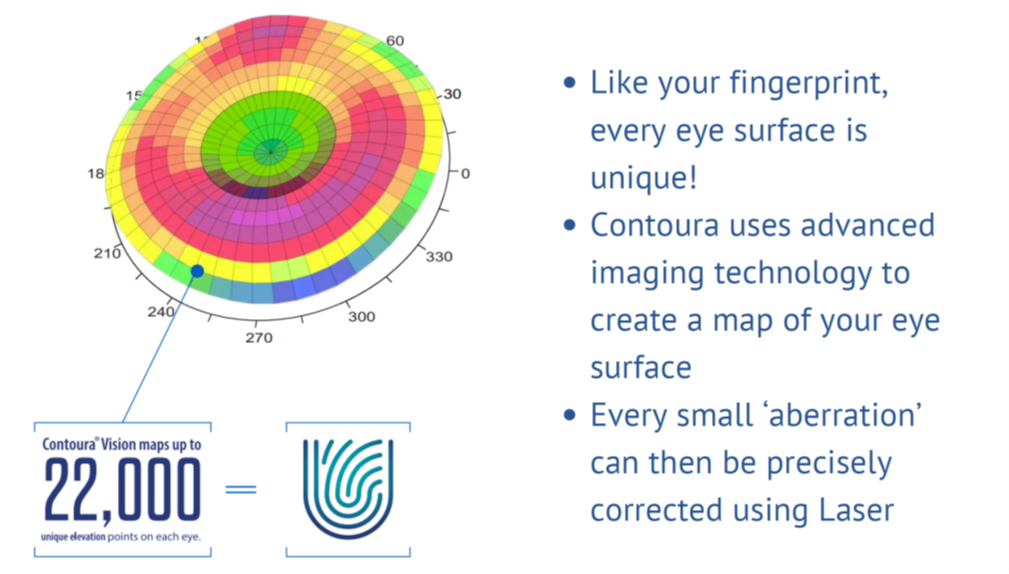
To understand how Contoura Vision works, here is a simple analogy. As you may know, every fingerprint is like a unique ID for us. Similarly, every eye is unique! Yes, the cornea of each eye has its own shape, with unique aberations and elevations on its surface – and this unique curvature affects how the light is focused on your retina and this means that your eye needs to be treated differently than someone else, for the best results.

Well, that’s exactly what Contoura Vision does. It’s the most highly customised LASIK procedure.
Contoura Vision uses advanced photoimaging technology to create a highly detailed view of your eye, mapping up-to 22000 points on your cornea. Compare this to the conventional LASIK, which maps only 200 points on the cornea and you will get an idea how precise Contoura Vision is.
But that’s not all. During Contoura Vision, the doctor uses AI-assisted and this detailed map to guide the laser beam more precisely sculpt and re-shape the cornea. So think of it as a guided, customised, perfect sculpting of the cornea , leading to the best possible vision correction outcome.
Moreover, this surgery offers good results even to those patients who were not eligible for undergoing LASIK surgery due to irregularities in the cornea.
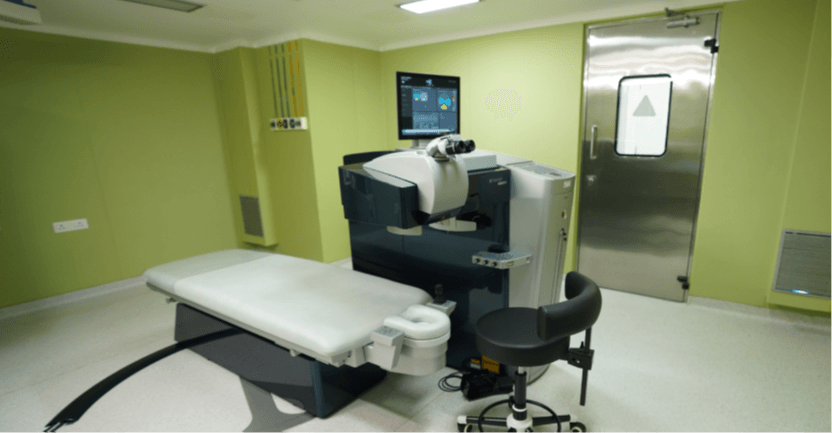
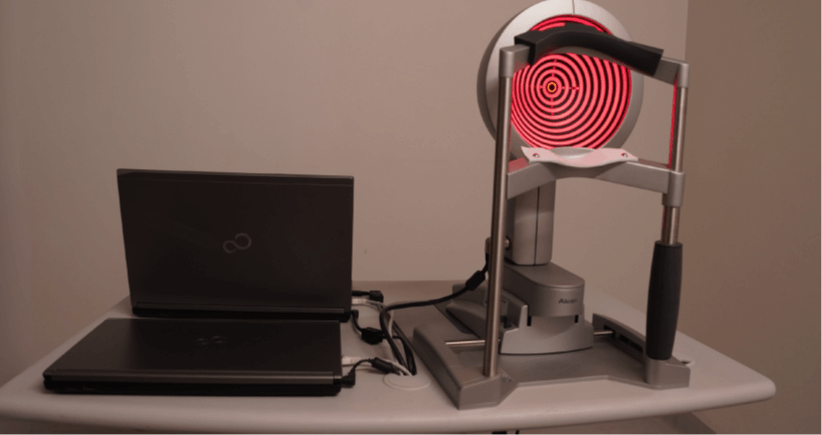
The machine that is involved in the Contoura vision includes WaveLight EX500 Excimer Laser Systems and WaveLight TopolyzerVario Diagnostic Device. The Topolyser offers unrivalled diagnostic accuracy to detect minor irregularities in the cornea’s curvature.
What is the benefit of Contoura Vision vs Conventional LASIK?
- Better results: The results of Contoura surgery are better as compared to Conventional LASIK in terms of visual clarity and correction in refractive error. Some of the patients experience corrections better than 6/6 ie. better than 20/20 vision.
- Broader scope: The scope of Contoura is not limited to vision correction – it can treat the abnormality in the corneal curvature.
- Advanced technology: The technology used in Contoura surgery is more advanced as compared to conventional LASIK surgery. While the conventional LASIK surgery maps only 200 points on the cornea, the Contoura vision surgery maps 22000 points on cornea.
- Faster healing and fewer post-surgery complications: Contoura vision surgery has fewer complications as compared to conventional LASIK surgery. The damage to the tissue is relatively less and has faster healing time.
- Patient comfort: Contoura surgery has no stitches, no injections, no pain, no bandages, and the patient may go home the same day of surgery.
Which Candidates Are Eligible for Contoura Vision Surgery?
Following patients are not eligible for undergoing Contoura vision surgery:
- Patients who are less than 18 years of age due to instability in vision.
- The patient suffering from immunodeficiency diseases
- Patients with vascular disease
- Patients with myopia higher than 9.00 D
- Patients with prominent nose and brow that obstructs refraction
The doctor will determine other criteria on a case-to-case basis, based on comprehensive examination of eye health.
What Precautions Should Be Followed While Choosing Centre for Contoura Vision Surgery?
Various centres claim to perform the Contoura vision with high success rates. Some of them are genuine while others make false and ambiguous claims. As eyes are vital organs, due diligence should be done in deciding the centre for undergoing Contoura vision surgery. Many centres advertise that they are performing Contoura vision but instead the surgery is done through conventional LASIK. Ask about the experience from friends or family members who have undergone Contoura vision surgery.
Reference: (Assorted research papers, medical sites and news reports.)