
Cataract changes happen in the eye slowly over a period of time. It is usually not necessary to go in for surgery in the early stages. When you feel that your day-to-day activities like reading, driving, cooking, etc. are getting hampered even after wearing glasses should you come in for a check-up and plan for surgery.

Mr. Oculus is here to give you a clearer view of the symptoms, diagnosis, and decision to go in for cataract surgery.
Rekhaben is a 65-year-old grandmom who is finding it increasingly difficult to prepare her grandkids’ favourite Chinese meals. “ Chopping vegetables for the noodles is getting more challenging by the day. My specs don’t seem to help either,” she shrugs. “What to do? I guess it’s just age.”
Rakesh is a senior management professional who loves long-road drives in his free time. “India by road is a beautiful experience,” he says. “I love driving long distances. But lately, it hasn’t been fun. On our last trip, I had to ask someone else to drive. I just can’t take the glare of the lights anymore. This is the same when I am working at my office computer-my vision seems to be blurred. And I am only 40.”
Then there’s 6-year-old Anand who can’t seem to note down the sums written by the teacher on the board during Maths class. “If he takes down the wrong numbers to begin with, then naturally the final answer will be wrong,” says his worried mom. “The same goes for spellings.”
In all of the above, the common cause of significant visual impairment or blurred vision is cataracts in the eyes or Motibindu as they are called in Hindi/Marathi. While Rekhaben and Rakesh have a senile or age-related cataract, Anand has a congenital cataract due to complications during his mother’s delivery.
Stranger in the Mirror: The warning symptoms.
Simply put, cataracts are a gradual, natural clouding of the eye’s crystalline lens. If the lens becomes too cloudy, objects might become blurred or hazy. In some cases, night time vision is a problem, in others, near-sightedness is the regrettable consequence. Still, others experience a fading or yellowing of colours before their eyes. Some might need a brighter, stronger light for reading while some might start seeing “halos” around lights. Then there are those who become hypersensitive to light and glare, while frequent changes in eyeglass or contact lens is an increasingly annoying new routine for some.
The US-based National Eye Institute has a simple explanation to offer: no matter how healthy you are, as the rest of your body ages, so do your eyes! And if you live to a ripe old age, you are more or less bound to develop a cataract or two. (A small price to be of that age, if one were to look at it philosophically!) You can’t prevent cataract; you can only deal with it correctly and promptly.
So far, so clear!
The black and white of it!
In case you suspect blurred vision, I, Mr. Oculus, would suggest a simple exam at home. Find a mirror. Check the pupil or the black dot in the centre of your eye, for this is typically the place where cataracts form. A fully black pupil would mean all is well and you are most likely cataract free. But a cloudy dot anywhere in the pupil would signal an onset of the disorder.
Besides, not every case automatically adds up to cataract surgery. In fact, ask yourself the answers to the following question: Like Rekha ben and Rakesh, are you finding it increasingly difficult to get on with your day-to-day personal or professional activities? Is reading a book, driving, or working at a computer no more fun due to blurred vision or sensitivity to the glare? Are your vision levels affecting your independence? Is night-time movement or driving a problem? Are you experiencing the strange experience of not being able to see your grandchild’s features as distinctively as before?
If the answer is yes, then it’s time to meet an expert ophthalmologist to get an eye check up, confirm the diagnosis, and know more about the treatment options, of which surgery is a possibility.
Please do note that self-diagnosis is only the starting point of a larger journey.
At no point must you consider going by it alone or taking ‘gyaan’ from well-meaning non-medicos, be they friends or family, or even the internet. You see, what confuses matters is that the symptoms of cataracts may resemble other eye conditions, so no way should you delay or avoid that visit. Remember timely diagnosis leads to effective treatment.
What diagnosis at the doctor looks like:
The complete details on your medical history, age, and lifestyle will be noted. Your eye doctor will now take an eye exam. Other procedures will include
- A visual acuity test: Never mind the intimidating name, this is just the latest version of the good old eye chart test.
- Pupil dilation with eye drops will allow the doctor a closer look at the retina.
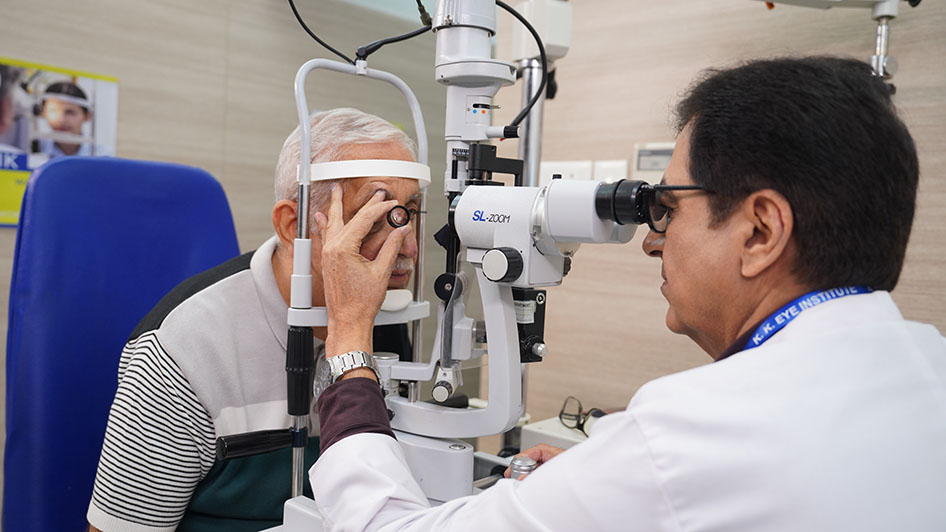
- Slit lamp test where you will be asked to sit with your head resting in the slit lamp microscope in order to get a closer look at the different structures at the front of the eye as well as inside the eye.
- Tonometry: An exam that checks pressure inside each eye.
If your cataract is just about beginning, you will be treated with eyeglasses. But as the stage advances, surgery is the only viable option.
Please note that your line of treatment will be individualised and customised for you keeping in mind your age, health, and medical history, the extent of the cataract’s development, and other existent eye problems.
Questions are good- ask without fear!
Of course, your opinion or concerns do count – so be sure to be open about what they are and why. For instance, Rekha ben was worried that taking time off for surgery would mean an inconvenience for her daughter because she takes care of the grandkids while their parents go to the office; similarly, Rakesh was heading a very busy and time-bound project at work; even as Anand would have to miss a week at school just before the exam. However, their doctors explained that it was worth taking time off to care for themselves. Once the surgery was done, Rekhaben would be able to take better care of her grandkids, while Rakesh would find working at the computer as well as driving – far easier. As for Anand, learning would become the joy that it is meant to be.
In short: honest conversations and careful, meticulous monitoring with your doctor/hospital usually yield positive solutions! Please ask in detail about the benefits and risks; what you can expect post-surgery. Will the operating surgeon be the one doing the follow-up or is it likely to be another ophthalmologist/optometrist?
Comfort, convenience, and confidence count.
Take your time reading up on the doctor as well as the hospital/Institute where the surgery will happen. What do other people say about them and what is written about them online? Are you, per se, comfortable with their approach and attitude towards you? Are they humane-please do note humane is not the opposite of ‘professionalism’; a true-blue professional surgeon or hospital is supposed to radiate the quality in every action! They are supposed to be honest yet kind, optimistic yet truthful, and realistic. Go with your instinct.
As for Rekha ben, Rakesh and Anand, their cataracts have been treated. The future is looking brighter and clearer for all three, so it’s time for me, Mr. Oculus to focus on post-operative care.
More on that in a bit, eye, err, I promise!
Eat healthy for healthy eyes
Research shows that foods rich in Vitamins C and E, apart from those that contain lutein and zeaxanthin, could bring down your risk of cataracts. While Vitamin C is found in citrus fruits, vitamin E is found in peanuts and peanut oil, wheatgerm oil, red bell peppers, almonds, and sunflower seeds. Similarly, lutein and zeaxanthin are found in spinach, parsley, green peas, red grapes, and sweet corn.
Reference: Assorted medical journals, websites, and news sources